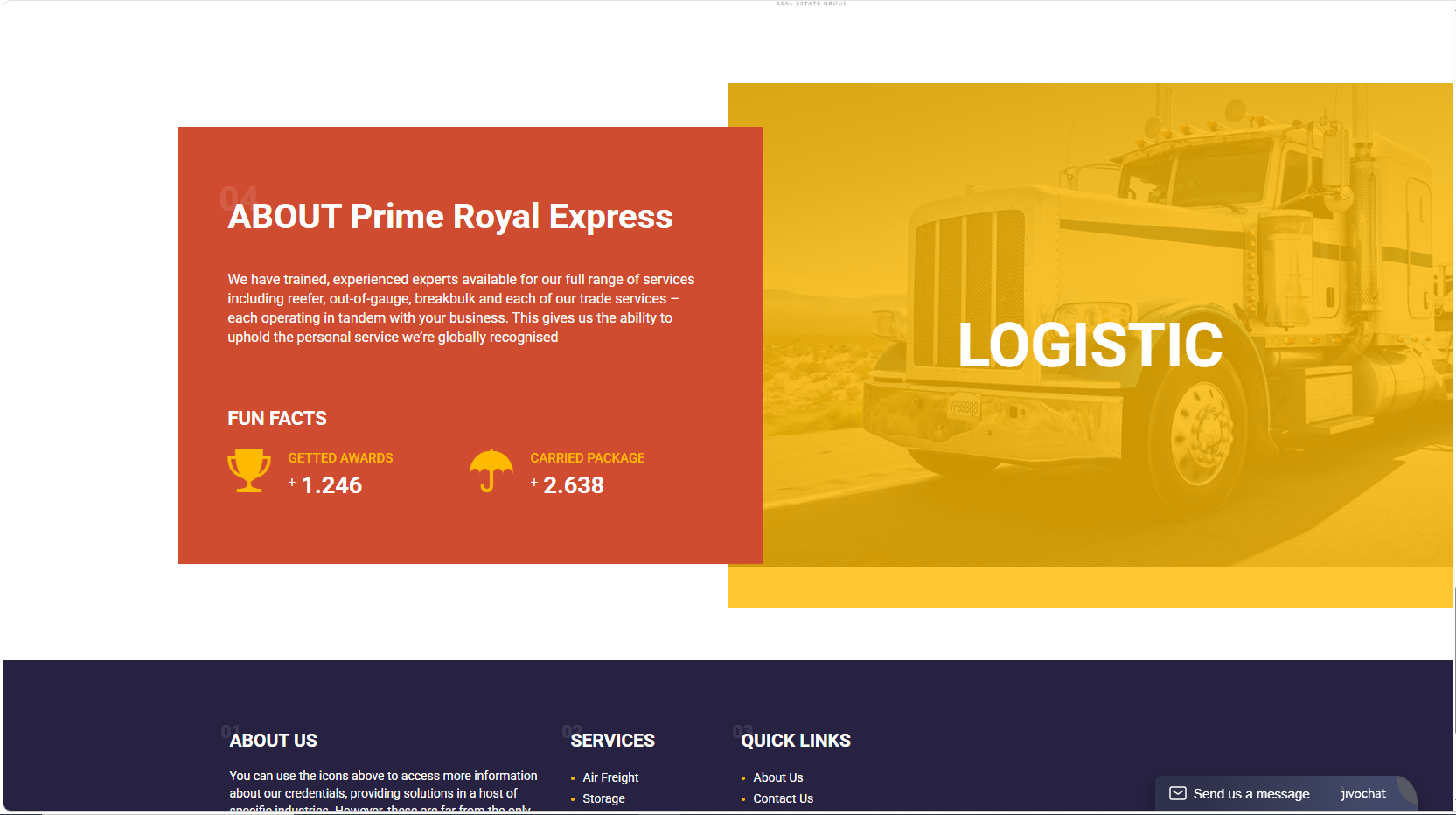

Review on Primeroyalexpress.com
PrimeRoyalExpress.com presents itself as an international logistics and shipping company that claims to offer worldwide package delivery, freight forwarding, cargo handling, courier transportation, and shipment tracking services. At first glance, the website attempts to create the appearance of a reliable logistics brand through professional wording, delivery-related visuals, shipment tracking tools, and bold promises about fast and secure transportation services.
However, once the website is examined more carefully, several troubling concerns begin to appear. The overall structure, presentation style, and operational claims resemble the pattern commonly seen with questionable logistics websites that operate primarily to gain user trust rather than provide real delivery services. Many fraudulent courier platforms are designed to look convincing enough to persuade users into believing that a shipment genuinely exists. Once trust is established, victims are often pressured into making additional payments for fabricated issues such as customs clearance, insurance fees, delivery holds, anti-terror checks, refundable deposits, or emergency transportation charges.
PrimeRoyalExpress.com raises concern because it lacks many of the characteristics that are usually associated with a legitimate and established logistics company. Authentic courier services generally maintain a strong operational footprint that includes transparent business registration details, verifiable office locations, clear ownership information, long-term customer reputation, active communication channels, and a visible history of service within the transportation industry. When these important trust signals are missing or difficult to verify, it naturally creates doubt about the credibility of the operation.
Another issue is the generic nature of the website itself. Suspicious logistics websites often rely heavily on broad promises and attractive marketing language while providing very little concrete evidence of real-world operations. Instead of demonstrating an established shipping infrastructure, they focus on creating urgency and emotional trust. In many situations involving questionable courier websites, users are convinced that a valuable package is already in transit. This psychological approach makes victims more willing to pay unexpected charges because they fear losing the shipment.
A major concern with websites like PrimeRoyalExpress.com is the possibility of financial manipulation. Some fake courier operations repeatedly demand payments by claiming that packages are being delayed for various reasons. Victims may be told that failure to pay immediately could result in package seizure, legal problems, or permanent cancellation of delivery. These tactics are specifically designed to create panic and pressure users into acting quickly without proper verification.
There are also concerns surrounding transparency and accountability. Legitimate logistics companies usually provide detailed company information, operational history, regulatory compliance data, customer service transparency, and publicly verifiable records. A suspicious logistics website often lacks this level of openness. Instead, users may encounter vague descriptions, generic wording, unverifiable claims, or limited proof that the business genuinely operates on a global scale.
Based on the visible warning signs and the behavioral patterns associated with suspicious courier operations, PrimeRoyalExpress.com should be approached with caution. Users should avoid making payments, sharing sensitive personal information, or relying solely on the website’s tracking system without conducting independent verification.
Notable Keypoints to note on primeroyalexpress.com
Legitimate logistics businesses are usually transparent about these details because trust is extremely important in the shipping industry.
One common feature of questionable logistics websites is the use of shipment tracking portals that appear genuine but may not connect to any real shipping network. Tracking updates can sometimes be manually generated to create the illusion that a package is moving through transit stages.
A common scam pattern involves requesting unexpected payments after users are informed that a shipment is already in progress.
A weak or unclear online presence can be a major warning sign.
Why PrimeRoyalExpress.com Raises Serious Concerns
The logistics industry depends heavily on trust. When individuals send valuable items or expect important deliveries, they rely on shipping companies to handle packages safely, professionally, and transparently. Because of this trust-based environment, fraudulent operators have increasingly targeted the logistics sector by creating fake courier websites that imitate real shipping businesses.
PrimeRoyalExpress.com displays several characteristics that raise concern about its legitimacy. One of the most noticeable issues is the attempt to establish credibility primarily through appearance rather than verifiable operational proof. Scam-oriented logistics websites often focus heavily on visual presentation because many users judge legitimacy based on design quality alone. A professional-looking interface can create false confidence even when the underlying business lacks authenticity.
A particularly concerning pattern associated with suspicious logistics websites is the use of emotional manipulation through shipment tracking. Once a user believes a package is already in transit, they become emotionally invested in receiving it. This creates a psychological advantage for scammers. The victim may feel pressure to resolve any “delivery issue” quickly in order to avoid losing the shipment.
In many cases involving questionable courier websites, users are later informed that the package has encountered a problem such as:
- Customs detention
- Insurance failure
- Security verification delays
- Tax clearance problems
- Transportation restrictions
The user is then asked to make an additional payment to release the shipment. Unfortunately, once one payment is made, further charges often follow. Victims may continue paying because they believe the package is real and close to delivery.
Another major issue is the absence of strong independent credibility. Real logistics companies usually build their reputation over many years through verified customer relationships, public business records, transportation partnerships, and operational transparency. Suspicious websites often lack this long-term footprint. Instead, they may rely almost entirely on their own website claims without meaningful third-party validation.
The communication style used by questionable courier platforms can also be highly manipulative. Users may receive urgent notices claiming:
- Immediate payment is required
- The package may be destroyed
- Authorities could confiscate the shipment
- Delivery rights will expire soon
These tactics are designed to trigger fear and urgency, preventing users from slowing down and verifying the legitimacy of the situation.
Another warning sign is the lack of detailed operational evidence. Established shipping companies typically provide:
- Clear business addresses
- Real customer support systems
- Public registration records
- Corporate leadership details
- Regulatory compliance information
When this information is vague, difficult to verify, or entirely absent, it becomes harder to trust the company’s claims.
There is also concern regarding the possibility of personal data misuse. Logistics websites often request sensitive details including names, addresses, phone numbers, identification documents, and payment information. If the platform is not legitimate, users may unknowingly expose themselves to financial fraud or identity-related risks.
Overall, PrimeRoyalExpress.com presents multiple warning signs that should not be ignored. While the website attempts to create the appearance of a trustworthy courier operation, the lack of transparency, questionable credibility indicators, and behavioral similarities to suspicious logistics schemes make it difficult to recommend trusting the platform without independent verification.